NewThe Unspoken Word2026
Evgeny Sukhov
RUEN

Notes

The Black Forest

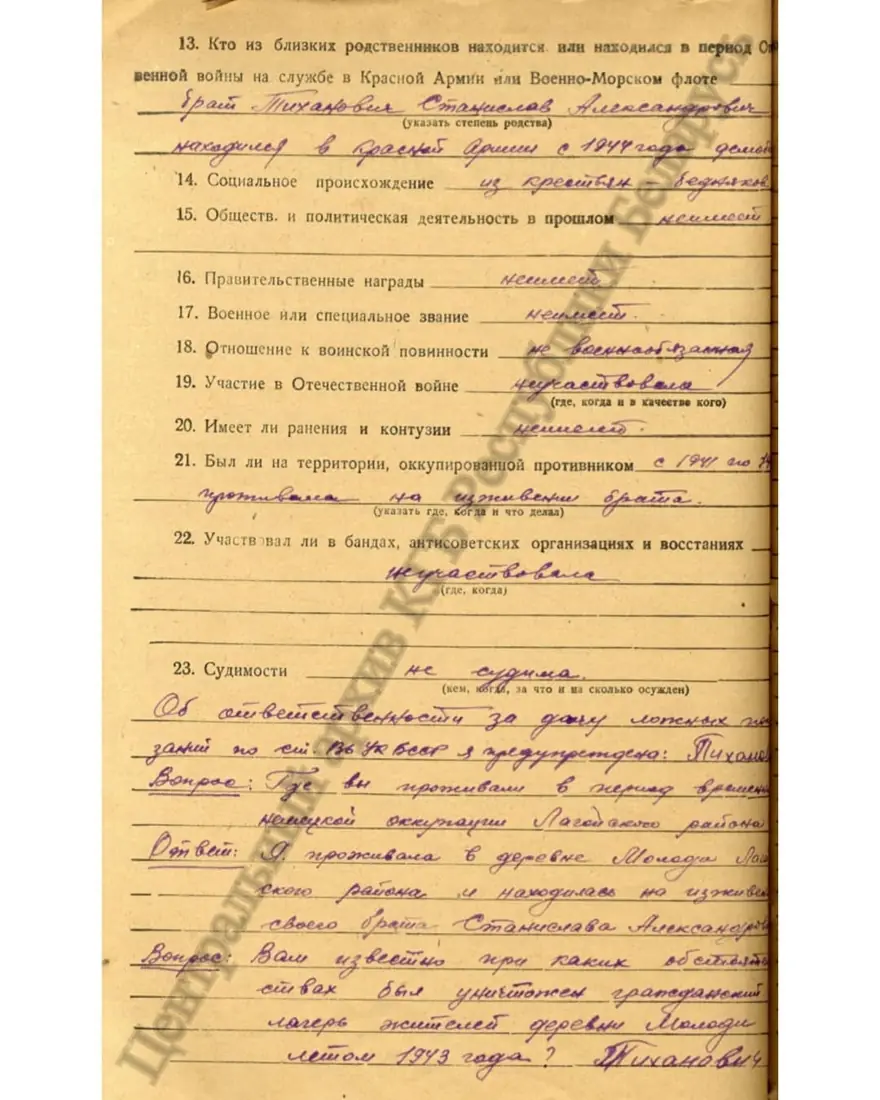
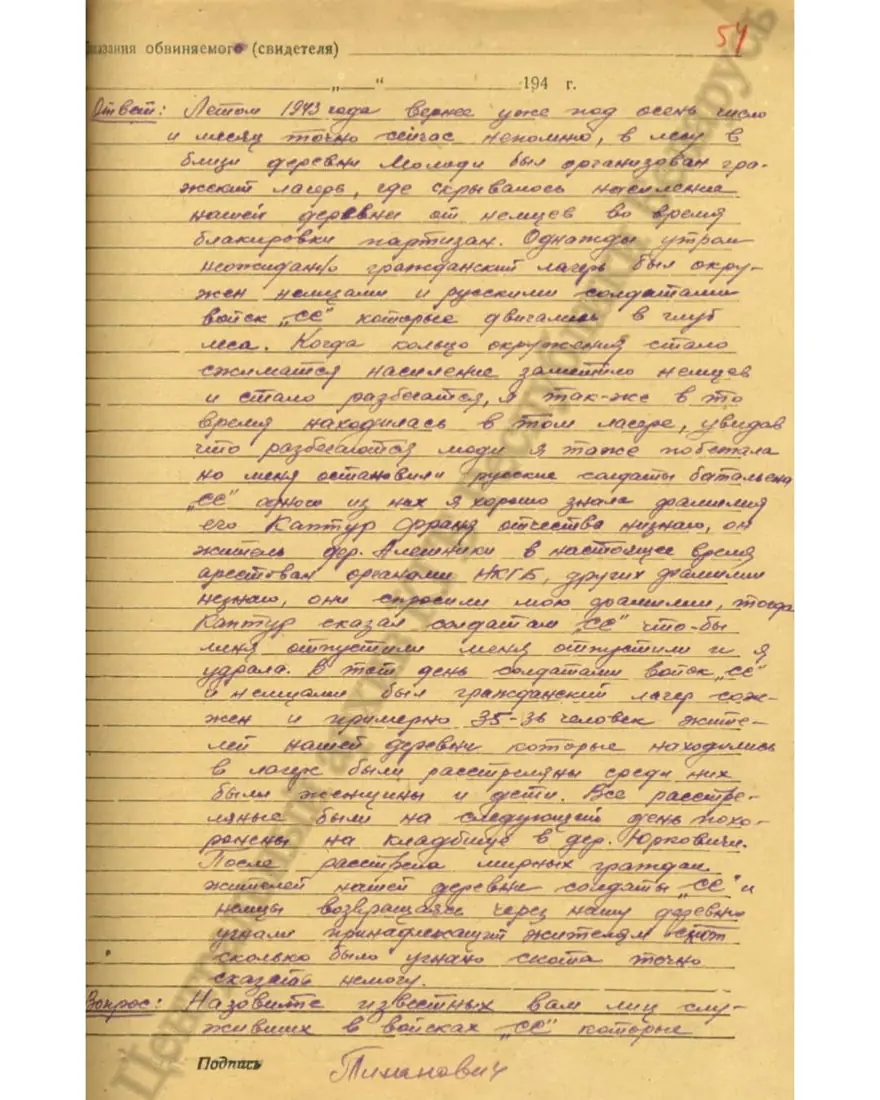
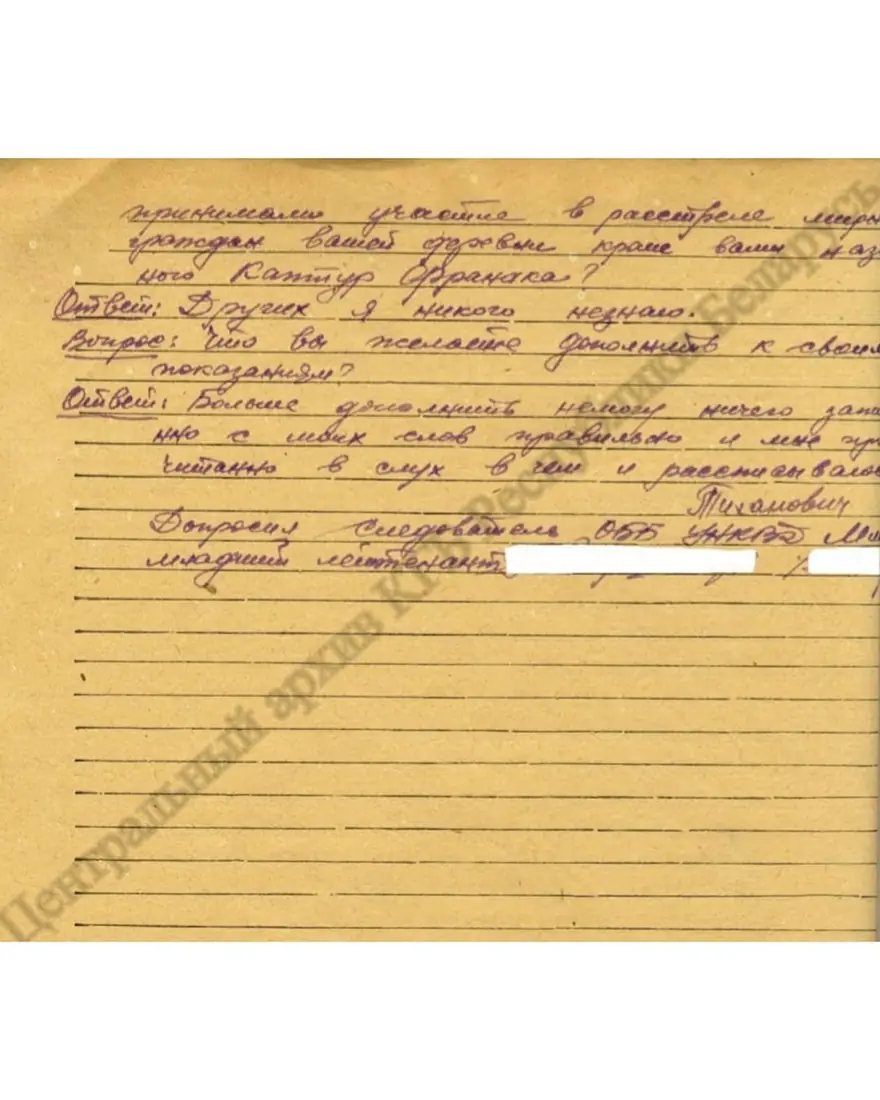
Eighteen instalments about the war and the author's family: occupation, uncles, a grandfather, a father's service in Germany, and an interrogation record.

Part 1

Part 1

This small town lies in the German region of Schwarzwald, which translates into Russian as “Black Forest”. The region is mentioned more than once in the fairy tales of the Brothers Grimm, and without adapted translations those tales are rather frightening.

Personally, I saw no horrors there at all. Quite the opposite: cleanliness, order, comfort. The rivers are incredibly clean and trout swim in them.

But I would like to draw your attention to the church. It is huge and majestic, and in size it is hardly inferior to St. Isaac’s Cathedral in Petersburg. And this is a provincial backwater of a German town.

The history of the town is this: first the church was built, and then people began to settle around it.

We went inside the church, and Karl, my cousin, a German, said:

- Take a look at the inscription under the dome. It was written right after the war.

The inscription read:

“We were divided, but we are one.”

Karl went on:

- I understood the meaning of those words later. When I was little, we weren’t allowed to talk about it. The subject was forbidden.

- And in this hall, - he pointed to a small room, - my father, your own uncle, married my mother.

I learned that I had a cousin in Germany only a few years ago.

To be continued
Original on Instagram ↗

↑→

Part 2

Part 2

I learned about the existence of my cousin living in Germany from relatives in Crimea (Dzhankoy, Sevastopol). After my mother’s death, contact with them had been broken for many years. But unexpectedly my sons decided to look into our family tree and track down relatives.

It was a cousin from Crimea who told me that my uncle had survived after being deported to Germany in 1942, and had died relatively recently.

After the war he married, fathered two sons and lived a hard but fairly long life, yet he never once came to Belarus, where he was from.

To some extent this news turned my world upside down.

The thing is that my mother had three full brothers, as well as a younger half-brother and half-sister.

The eldest brother was deported to Germany, the middle brother was shot by the Germans in the first days of the war. He was studying at a FZO vocational school, he was wearing a student uniform, and the Germans took him for a soldier. My grandfather Alexander learned of his killing from fellow villagers, who told him where he lay, but my grandfather never found him (most likely he had simply been thrown into some pit and covered over) and grieved terribly over his death.

The youngest brother fought as a partisan and then, after the liberation of Belarus, went to the front.

Evidently women have some kind of instinct, intuition, foresight, call it what you like, that men do not possess, which is why it is sometimes so hard for us to understand them, but my mother was absolutely certain that her eldest brother, whom she loved more than the others and who had always protected her, was alive.

Personally, her assertions always made me very sceptical: if he were alive, he would surely have made himself known somehow, but nothing of the kind ever happened.

And now, many years later, I understand how wrong I was.

As proof that she was right, she told me about two occasions when, supposedly, two messages had come from her eldest brother, one written and the other oral.

This was in the early fifties, of the last century now. At the time she worked at the Minsk plant “Radiopribor” and lived in a women’s hostel.

. . [Continued in the comment below]

Original on Instagram ↗

←↑→

Part 3

Part 3

My uncle was tracked down through the International Red Cross. One of my nephews living in Belarus sent a request to Germany and, quite unexpectedly and very quickly, an answer came. The letter said: such a person exists, and below was written the address where he lived.

My Crimean uncle immediately wrote to his elder brother and received a warm reply. He did not want to leave Germany and come to visit, but he sent his younger brother an invitation.

And Uncle S. decided to go. Alone. And without even letting his elder brother, whom he had not seen for fifty years, know that he might turn up.

Credit where credit is due to the Crimean uncle. In his day he was a fighter. He had been a partisan from about the age of 15. And he showed the enemy no mercy. And when, after the liberation of Belarus, he was taken into the regular army, he showed his character in full there too.

He came home a hero, with medals and orders.

We once visited him in Crimea. I was not many years old then, but I remember a lot of those conversations. For example, he told us that when he was ordered to take German prisoners to a POW camp or to some headquarters, and by the end of the war they surrendered literally in droves, he never brought a single one of them to the destination. He simply led them into the forest and shot them! And when he was asked whether he had delivered them, he answered that he had. Only where to....

I have no right to judge.

After all these decades it is hard to judge the actions of an eighteen-year-old boy. But I understand his state of mind perfectly well. The Germans had killed his father and one of his older brothers, another older brother had been deported to Germany, his house had been burned down, and his village had been burned too, together with its inhabitants. And there were hundreds of other deaths that, by the will of war, he witnessed.

To be continued.

Original on Instagram ↗

←↑→

Part 4

Part 4

My two own uncles, one who fought as a partisan and later served in regular units of the Red Army (Uncle S.), and the other who was deported by the Germans to Germany (Uncle I.), saw each other exactly fifty years after their last meeting in 1942.

The meeting took place in Germany, in Uncle I.’s house, where he lived with his family. It happened precisely on 24 December, the day before Christmas, a holy day for Catholics, the main holiday of the year. Both of them were Catholics, so I think the meeting was predestined.

I am still amazed at how Uncle S. got to Germany from Crimea, and all the way to its farthest corner, not knowing German, never having been abroad (I don’t count the end of the war, when the fascists were being driven across all of Europe), and having seen Germans themselves before only through the sight of his submachine gun. But he made it. He knocked on the door, and they opened it. The brothers recognised each other instantly. They embraced, burst into tears, everything as it should be.

I confess I would very much have liked to witness that meeting, to hear what they said and how they talked to each other. Whether they remembered my mother, their younger sister, who by then was no longer alive. Whether they commemorated their father and the brother killed by the Germans. Whether they recalled their village of Molodi in the Logoisk district, burned by Ukrainian nationalists, punitive troops from the “Nachtigall” battalion. And in general I’d love to know what they talked about for a whole month. To see the expressions on their faces. To hear their intonations.

Uncle I. had lived fifty years in Germany and had thoroughly forgotten Russian, but they understood each other. Sometimes a neighbour would come, a former Soviet citizen who had moved to Germany back in the seventies, and help them communicate.

The local press took an interest in such a remarkable meeting and ran a report on the event.

Only it did not say a word about the fact that Uncle S. drank heavily the whole time.

To be continued.

Original on Instagram ↗

←↑→

Part 5

Part 5

The fate of my eldest uncle I., deported by the Germans to Germany for forced labour, turned out to be very unusual. There is room in it for tragedy, adventure and even love...

He was a sturdy village lad, he understood and loved the land, and he was sent to a rural area. You could say he was lucky. Others fared far worse.

In Germany he had two masters, whom we would call “kulaks”, owners of huge tracts of land on which grain crops were grown.

The first master treated him like a slave, and he worked like a slave and did slave labour, but the second treated him like a human being. He had a daughter, and a romance later grew up between her and my uncle. My uncle learned German quickly and even spoke the local dialect.

But after a while he decided to escape. Switzerland was not far, and he ran away there.

For some time my uncle worked in that country and even mastered the Swiss dialect. He could have stayed there until the end of his days, but he decided to make his way to France, where he wanted to join the Resistance.

He managed it, and fought in Resistance units, finishing off the remnants of the German forces.

For some time after the war my uncle lived in France and learned French, but he never forgot his master’s daughter, whom he had loved, and decided to return to Germany.

But when he came back to his former master, he was detained by the American authorities, who, in accordance with the Yalta agreements, decided to hand him over to Soviet representatives together with other Soviet citizens.

They loaded him into a truck and drove him toward the Soviet zone of Germany. My uncle already had an idea of what awaited him. It was no secret any more, people knew about it, talked about it openly, and warned him too.

And at night, during the transfer, he escaped, together with a lad just like himself. They were guarded by an American, who fired shots. But, as my uncle said, he fired more for show.

And my uncle made his way across all of Germany to his former master, to the daughter he loved.

He reached the master and told him what had happened to him. Together they began to think about what to do next.

Continued in the comment

Original on Instagram ↗

←↑→

Part 6

Part 6

About three years ago I was returning from Moscow to Kazan. Two young men were travelling in the compartment with me. As happens on the road, we soon got talking. One of them suddenly asked me: “By any chance, are you a Tatar?”

I am used to such a question. I have been asked it more than once. I first came across it when I went far from home.

On geological fieldwork placements (in Magadan, on Chukotka, on Sakhalin), on learning that I was from Kazan, people invariably asked about my nationality.

Sometimes they didn’t believe me, insisting: “If you’re from Tatarstan, you’re a Tatar.” Arguments that besides Tatars the republic is home to Russians, who may even be more numerous, and to other nationalities too, somehow never achieved the desired result.

So I met my fellow travellers’ question quite calmly and explained in detail: “On my grandfather’s side, I descend from Zaporozhian Cossacks, though there is a line of Don Cossacks too. My grandmother Lidia Alekseeva is from Kazan, a native Kazanian, where many generations of Alekseevs have lived. But my mother is from Belarus.”

Suddenly they became interested:

- From Belarus? Where exactly?

- From the Logoisk district.

- From Logoisk.... - I heard respect in their words. - Only now it’s not a district any more, it’s already a town. - I was there twice in my childhood. But I remember that area very well. There’s a river there, the Gaina! There was a huge amount of fish in it. The perch were very big. And all around there were lots of lakes with crucian carp. People caught them with their bare hands. - That’s all true... There’s still plenty of fish in the river.

- There was also a dam there, I remember the older boys used to jump off it. The dam was high. They weren’t afraid...

- The dam is still standing there. - And he suddenly added: - Only you won’t find forests like the ones that used to be. You can’t hide in them any more.

He looked at me point-blank, and he knew that I understood him.

Belarus is a long-suffering republic, one in every four died, but Logoisk suffered more than any other district in comparison. It was in this very district that the village of Khatyn stood, which the punitive troops burned to the ground together with its inhabitants. *continued in the comment*

Original on Instagram ↗

←↑→

Part 7

Part 7

Once I asked my mother:

- Were there a lot of traitors during the war?

- Plenty! You can’t even imagine how many traitors there would be now if some kind of coup happened!

This conversation took place not in the nineties, when there was chaos and drift (though little has changed since then), but in the seventies, when Soviet power was as strong as ever. Of course, nobody could even have imagined an upcoming coup.

- And what made them become traitors?

- There were many reasons. Some wanted to give orders, to dispose of human lives, to settle scores. Some were ready to serve the Germans just because they gave better clothes. Out of some selfish interests. And there were those who simply didn’t like the authorities.

- And did the policemen kill?

- Only the policemen did the killing! They burned people, they shot them, they tortured, they raped, they tormented. The Germans did not dirty their hands with such work. They only gave orders. A German would stand to one side, smoking and watching people being driven into a barn, the barn being piled around with hay and set on fire. That’s why the policemen were hated far more than the Germans.

- And how did they dress?

- Differently... Some just wore civilian clothes, with a white armband on the sleeve.

- And how did the round-ups happen?

- When they saw lorries driving toward the village, they would shout: “Germans! Germans!” And the whole village ran to the forest. And the policemen and Germans shot at those running. - Pointing to a scar on her heel, she said: - That’s a bullet mark. My girlfriend, who I was running with, was killed in the back, but I was lucky. We were twelve years old then. Then you run into the forest and your teeth chatter. But you treat death simply. You think, tomorrow they’ll kill him, and then me. And once I didn’t manage to run away and hid in a barrel and closed the lid. And then the Germans came up to the barrel and started rocking on it. And I kept thinking, any moment now the lid will fall off and they’ll see me. But they left.

To be continued

Original on Instagram ↗

←↑→

Part 8

Part 8

I once happened to read a statement by some liberal who, “with an air of expertise”, proclaimed that the Germans were met in the Soviet Union with bread and salt. In Western Ukraine that did happen, they were met so. Because those people are not even Ukrainians, still less Russians. It is such a mixture of peoples and nations that passed through that land, assimilated, lost their identity, acquired some other kind of community, put down roots in foreign soil, that they simply were reborn as a different people, with a lot of Polish, Hungarian and even Lithuanian in them.

Perhaps it is from here that Western Europe has some squeamishness toward people from Western Ukraine, which now extends to the whole rest of the country.

But that is not what I am talking about now...

I want to note that before the Great Patriotic War people really did live badly, especially in the countryside, and of course everyone wanted change, but not the kind where an enemy comes into our country, supposedly in order to “make our life better”.

I will tell you one episode that took place in Belarus, in the Logoisk district, in the most partisan region of the republic.

When the Germans rode into the village on motorcycles, a group of “activists” met them with bread and salt.

- The little masters have come, the little masters, - they said (frankly, I think they weren’t even Belarusians but Poles. A characteristic form of address. And there were many of them in Belarus then).

The Germans lined the “activists” up in a row, pulled down their trousers and, laughing, sprayed streams of urine on their faces. And then, still laughing, they drove off to establish the “new order” further on.

In the people who greeted them, the Germans saw only barbarians, unworthy of respect.

So there you have it..... Afterwards the whole district laughed spitefully at those “activists”:

- You met your masters with bread and salt? Well, you got “salty dew” in your face!

And one more thing....

More than once I asked my mother whether she had helped the partisans. I wanted to hear some gripping story, but she answered in a very ordinary way.

- No... Except that when we were gathering berries in the forest, partisans would come up and ask us to pass something on, by word of mouth, to someone. Sometimes we carried notes. But that doesn’t really count.... - And did it happen many times?

.

.

[continued in the comment]

Original on Instagram ↗

←↑→

Part 9

Part 9

The village of Molodi, where my mother lived, is only a few kilometres from Khatyn, which was burned together with its inhabitants in March 1943.

I want to note that before that the punitive troops had also burned Belarusian villages, but most often the houses were left empty, because the inhabitants had managed to run to the forest. The punitive troops came to Khatyn at night and nobody had time to hide... The same thing happened to the village of Molodi. The punitive troops, mostly made up of Ukrainian nationalists, arrived towards morning, surrounded the village and began driving into a barn everyone who had not managed to run to the forest. Several dozen villagers were gathered, among them my twelve-year-old mother. The villagers understood perfectly well what would happen to them next.

A scream, weeping and shouting hung over the village, shots rang out. And then my mother saw among the policemen a lad she knew from a neighbouring village and began to beg him:

- Uncle, let me go, I have no dad, no mum. You know me, my name is Zosia.... Let me go... You know my older brother, let me go.

- Where is your brother now?

- He’s not here... The Germans took him away to Germany.

- All right. Just don’t say anything.

The policeman took my mother by the hand, led her to the edge of the village, brought her out of the cordon and said:

- Run quick, before anyone sees!

The forest was literally a few metres from the village, and she disappeared into it.

Few managed to escape. The village of Molodi was burned together with its inhabitants

This story has a sequel...

In 1944, right after our troops liberated Belarus, the military counterintelligence “Smersh” began to hunt for traitors among the local population. There turned out to be quite a few of them. They were hanged right in the district centre, and their corpses stank for a long time.

They caught the policeman who had let my mother go, too. Under interrogation he said that he had not burned or killed anyone, but had only stood in the cordon and had even saved someone. And here he referred to my mother.

- You can ask the girl Zosia from Molodi. I led her out of the cordon at my own risk.

.

[Continued in the comment]

Original on Instagram ↗

←↑→

Part 10

Part 10

To write an interesting and authentic novel you have to talk to the people who took part in the events and get into the details. That is exactly how I worked when I wrote about the Kormakov gang: I talked to officers of the Kazan department for combating banditry. Within a short time they died one after another, as if they had been waiting for me to appear in order to make their confession.

I also talked to the former head of the Kazan criminal investigation department in the twenties; at the time of our meeting he had turned 101. His biography contains quite a few curious facts: he was turned down by the Red Army for health reasons, and he later served 15 years in the camps.

He told me a great deal of interesting things you won’t find even in documentary non-fiction.

Even his cooking was interesting: he preferred perepechi with vinegar. He would pour vinegar into a deep bowl, dunk the perepech in it generously, and then bite off small pieces.

What my mother told me about the war and the German occupation of Belarus is also very interesting and not open to the slightest doubt. I regret that at times I lacked the proper patience and did not always ask about the details.

Once I asked when our people showed up.

- We saw them as they were coming through the forest. They weren’t supposed to be there at all, it’s swamp, and yet they suddenly appeared.

Once I asked:

- Were there Germans who stayed with us?

- There were. I only know three such families, in reality there were far more. They served their time here with us for five years, building buildings, and then didn’t want to go back to Germany and stayed in Logoisk.

- And how were they treated? They were Germans after all?

- Normally. People got used to them, and besides, they had already served their time... They married here and had children. Nobody harassed them. They lived like everyone else.

The Russian person is merciful and can understand even an enemy; what he cannot forgive is betrayal.

Original on Instagram ↗

←↑→

Part 11

Part 11

I kept wondering whether to write about this or not....

And I couldn’t hold back, so I’m writing! Evidently there lives in me not only a writer but also a researcher.

One should not walk the beaten paths; one should create something new that nobody has written before you.

That is exactly how my two books about the Kazan Khanate came about (in Russian this period was passed over in silence), and the novel “I Am a Thief in Law”, which started a whole series.

To be honest, I haven’t written about thieves for a very long time, yet my name is still linked precisely with those books. Although I have many detective novels and historical books too.... And I’m sure they are all good!

And here’s the point: in the German frontline zone, brothels operated for German soldiers and officers. At one time the press wrote that only German women and girls from the Baltic states “worked” in them. But that is not so, there were local girls too. But I would like to draw attention to one interesting detail. These girls did not need to carry documents; they were stamped on the thigh. And if they needed to leave the frontline zone, enter it, or simply pass through a checkpoint, the girls lifted their dress over the leg and showed this wretched stamp. The Germans on duty at the checkpoint just laughed cheerfully and let the girl through.

I remember that after listening to my mother’s story I asked her:

- Was it really a stamp? Maybe they were tattooed on the thigh?

She answered:

- No, a real stamp that didn’t wash off. I was already working at the Minsk Radiopribor plant and we had three such girls in our shop. And several years had already passed since the war.

- And how did you treat them? After all, they had somehow been with Germans...

- Normally. Nobody reproached them or pointed a finger at them. They had suffered and endured enough as it was. And what war is, we knew perfectly well.

I would like to say this. In France, which practically took Germany’s side, women who had relations with Germans had their heads shaved, were paraded naked through the streets, and sometimes were even killed. But in Russia, a country that had suffered from the aggressor, where violence and murder were the norm, such women were not condemned.

This is yet another trait of our people.

Original on Instagram ↗

←↑→

Part 12

Part 12

It soon became clear that our troops had come to Germany “in earnest and for a long time”. Huge construction was under way in the Soviet zone: engineers, workers and simply skilled hands were needed. People began to be invited to work in Germany, and of course high wages were promised.

There were many who wanted to go to Germany, but not everyone could pass through the sieve of thorough vetting; the selection was quite strict. The applicant’s biography had to be impeccable!

My mother also decided to work in Germany together with her girlfriends. But not all of her friends passed the check: some had relatives who turned out to be policemen, others had relatives exposed as traitors, and there were even those who had served the Germans themselves... There were many reasons for rejection.

My mother’s biography was a worthy one. I can say, not without pride, that all her relatives had been partisans and fought. So she had no problems.

All that remained was to pass the interview, and to the question of why she was going abroad she said frankly that she would like to find out the fate of her elder brother, deported by the Germans to Germany.

One of the examiners barely smiled, and one can only guess what this “Mona Lisa smile” concealed. But her frankness did not become a bar to departure.

My mother was sent to Wunsdorf, a district of the town of Zossen. And in Wunsdorf were stationed the headquarters of the Commander-in-Chief of the Group of Soviet Forces in Germany (GSVG), the GSVG staff. The territory of Wunsdorf was closed to citizens of the GDR (interestingly, Wunsdorf had earlier housed the High Command of the Wehrmacht’s ground forces).

It was there that she met my father, and it was there that I was destined to be born. However, registering newborns in Wunsdorf was not allowed, so I was registered in nearby Potsdam.

And even now, when I show my passport in various official places, I am often asked:

- Do you have German citizenship?

- No, Russian.

Somewhere in the early 2000s I found out quite by chance that people born in Germany were allowed to visit their birthplace.

And in general I would like to visit the place where my father once served, where he met my mother, and where they were once truly happy.

To be continued

Original on Instagram ↗

←↑→

Part 13

Part 13

In Europe at the end of the fifties and the beginning of the sixties of the last century the situation was very tense. This is not talked about at all, but servicemen in Germany lived in expectation of some serious trouble with the West. That is why even children born in Germany were not always registered, for fear that in the event of a possible conflict such servicemen’s families would be the first to suffer.

So registering a child abroad was an act of courage.

My father called me all his life: “This is my German one.”

His duties took him to Berlin more than once, and he often took my mother with him.

Once, while strolling, they accidentally wandered into the Western zone, because the Berlin Wall did not yet exist.

My mother told me later:

- I look around and see that people are dressed somehow differently. And the soldiers have a different uniform.

My father, who was also in military uniform, quickly got his bearings and cried out, pulling my mother by the hand:

- Let’s get out of here!

They ran through side streets into East Berlin, and never told anyone that they had accidentally ended up in West Berlin.

And West German intelligence worked very efficiently, and there is factual confirmation of this. After all, it was headed by Reinhard Gehlen, a former senior officer of the Abwehr.

My father told me of a case where a staff clerk was abducted by West German special services from East Berlin, from the very part where he served. Our command pressed for a long time to have him returned. Finally he was handed over to our authorities, but badly beaten up.

As it turned out, the West German special services had interrogated the soldier-clerk intensively. For some time he lay in hospital, recovering. Meanwhile all the circumstances of the case were looked into, whether he had told them anything. And when they were convinced that he had behaved heroically, they returned him to his unit. Only no longer as a clerk: he received an officer’s rank, junior lieutenant.

So the wall in East Berlin was a necessity.

Original on Instagram ↗

←↑→

Part 14

Part 14

Wunsdorf. Germany.

- When they told me I’d had a son, I jumped into a tank and raced to the maternity hospital, - my father told me many years later. - I pull up at the hospital, and everyone runs out into the street, looking to see who has come rolling up in a tank. Women look out of the windows. But your mother isn’t there. I shout to them, call Sonia! Sukhova! Then she came to the window and waved to me, and then I see she’s signalling, go away from here, you can’t! They’ll scold us. And I climbed onto the turret of the tank and shouted to her:

- Show me my son!

She waved her hands at me and showed that he wasn’t with her at the moment, he’d been taken away.

And I shouted to her again:

- Bring him, show him to me! I won’t leave until you show me.

She only shook her head. I look - she’s gone. After a while she comes back with you in her arms, holds you up to the glass, and I see her say: “Look.” And you’re yelling something there, very displeased.

I looked at you, climbed back into the tank, and drove back.

- Were there any penalties? After all, the GSVG headquarters was there.

- It all passed off... Maybe they took the situation into account, or maybe they didn’t understand what was going on there, or maybe because I was in good standing with the command. I don’t know! On the contrary, afterwards they even joked about it.... And you know, quite recently I met some of the guys I served with there. And they happened to remember that very incident. We laughed about it too.... They said that neither before you nor after had anyone driven up to the maternity hospital in a tank.

To be continued

Original on Instagram ↗

←↑→

Part 15

Part 15

My father served in Germany for seven long years. High time to return.

Once he told me: “Service in Germany was interesting, of course. We had a model company, I got to see the whole government, Khrushchev included. And then I met your mother there. But I damn well missed the motherland! And I wanted to come back.”

This was Khrushchev’s time, when the armed forces were being cut. So many servicemen were given a choice.

My father decided to return.

I was eight months old when we arrived in Kazan. We settled on Malaya Krasnaya Street, where my father’s parents lived.

Almost immediately after arriving from Germany my father went to the tank military school, where he planned to continue his service. He got approval, and only one thing remained: a meeting with the head of the school.

When the head of the school walked into the reception room, the two officers who were applying with him immediately stood up. My father stayed seated, because he was in civilian clothes. The general looked closely at my father, shifted his gaze to the two officers standing at attention and gave an order to the secretary:

- I’ll take these two, but this one, - he glanced at my father, - no!

I never heard this story from my father (my mother told it to me), perhaps because the memory was unpleasant. But he did what he considered right. It was impossible to persuade him otherwise; that is simply fate. I knew his answer, which he said to my mother more than once:

- I was in civvies! And I wasn’t obliged to stand up.

To some extent the stability, and with it the modest prosperity they had grown used to in Germany, was badly shaken. My father had to look for a job, and later he got a post as an engineer at “Radiopribor”.

Many years later I once asked him to tell me about that incident. Smiling, he retold what I already knew and added, with an inner rightness that nothing could shake:

- I was in civvies.

Almost immediately after our arrival in Kazan my grandmother Lidia Vasilyevna Sukhova (Alekseeva), without my mother’s knowledge, had me baptised in the church at the Arskoe cemetery. I became Orthodox. Perhaps my grandmother had her own reason for doing it in secret.

.

Original on Instagram ↗

←↑→

Part 16

Part 16

For as long as I can remember, on my grandfather’s old television set, in a plain wooden frame, stood a photograph of a young man in Cossack uniform with a sabre at his side and two St. George Crosses on his chest. An attractive face, mischievous eyes, a neatly trimmed moustache under a straight, thin nose.

This is my great-grandfather.

It was always interesting to look at him. Every time I went up to the portrait, I seemed to see new features in his appearance that I hadn’t noticed before. My grandfather liked that. He would come up to me and say:

- Little one, we come from Zaporozhian Cossacks.

- Grandad, you’ve told me that a hundred times.

- Well, listen a hundred and first time, little one, nothing will happen to you.

I confess I don’t even remember my grandfather calling me by name. Only like this: “little one”. He made no exception even when I was over thirty and had children of my own.

Still, it would have been a sin to take offence.

- Our ancestors were all Cossacks! They always were, two hundred and three hundred years ago! And you know... My father should have had four St. George Crosses....

- And where did they go?

- My father traded them for leave during the war. There were three of us brothers and an elder sister. And we were all born before the Imperialist War (strangely, that’s what he called the First World War). My father already had two St. George Crosses, and the third was about to be presented. He had distinguished himself in something. And he says, give me leave instead of the Cross, I have a young wife with four children, I need to check on how she’s getting on. So they gave it to him. And then they were going to give him another. They said, well done, Sukhov, you distinguished yourself, you’ll get a Cross. And he’s at it again: “Give me leave, I need to see my wife.” They gave it.... Although at that time they didn’t often let people go on leave.

My grandfather loved to talk. He recalled what seemed to me like prehistoric times.

- And do you know how mighty my grandfather was?

- How would I know? - I looked at the badly decrepit old man.

- He could sit on two chairs! A real Cossack! He lived a hundred and one years... I remember him, he always lay on the stove bench.... And once when he was climbing down from the stove, he twisted his leg. They wanted to call a healer to set it, and he says: “No need, I’ll die in the morning.”

Original on Instagram ↗

←↑→

Part 17

Part 17

When I hear old Cossack songs, my soul freezes. Briefly; then it falls in step with the sound and somehow calms down. I think this state is called “the voice of blood”.

Once I asked my grandfather:

- Did your father, my great-grandfather, fight in the Civil War?

- Of course he fought, he was a Cossack. - And then, with a feeling whose meaning I never worked out, he added: - He was some swordsman! Who didn’t he fight with...

I never managed to get my grandfather to open up. There was clearly something he did not want to talk about. After all, he came from Gulyai-Pole. Who knows, maybe he fought alongside Makhno, or maybe against him for the Reds. Or maybe for the Whites. I don’t know! If I had such an opportunity now, I would certainly get my grandfather talking.

But my great-grandfather’s fate turned out such that he could no longer stay in his native stanitsa, and with his wife and four children he went first to Azerbaijan and from there to Kazan.

My grandfather told me that they settled on Kozya Grivka, which was then on the edge of Kazan. A restless, rowdy place. Gypsies often camped there, and my grandfather, a small boy, was friendly with them.

And the Gypsies, who were fond of him, said:

- Kolka, show us where you live, we won’t steal there.

And they really didn’t steal.

I remember when I came to him with my one-year-old son, the old grandfather, by then blind, asked to hold his great-grandson. He grew sentimental, feeling the child’s warmth, shed a bitter tear, and then said:

- A Cossack is growing up.

To be concluded.

Original on Instagram ↗

←↑→

Part 18

Part 18

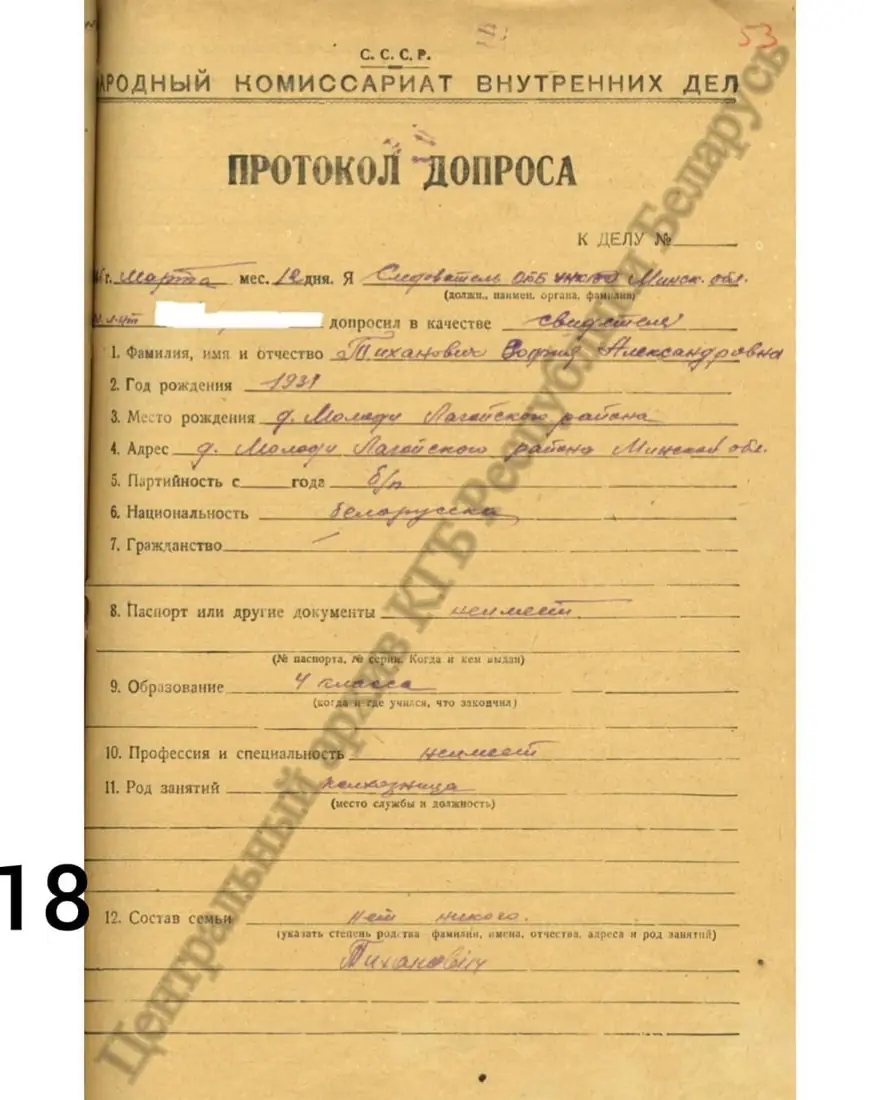
When I was writing part 9 of “The Black Forest”, in which I told how a policeman led my twelve-year-old mother out of the cordon and let her go into the forest, I never thought I would be writing precisely this ending. But it came out just so... A few days ago my elder son found on the internet the transcripts of her interrogation by a “Smersh” officer, in which he asked: “Did the policeman really save you, as he claims?” My mother confirmed his words.

She was fifteen then, as old as my daughter is now, also named Sofia. The traitor’s surname was Kaptur, and he served his sentence in full. Thirty-six people were killed in Molodi then, the village was burned, the livestock driven off. Among those shot were many children, and my mother should have been lying there too...

These transcripts are now openly accessible. My elder son simply typed in the district “Logoisk”, the village “Molodi”, and the document popped up at once.

My mother Sofia appeared as a witness in the mass murder of civilians by punitive troops.

To be honest, after reading this document I walked around all day not myself. I calmed down only by evening.

That girl at the interrogation, fifteen years old, would later become my mother, and I would wake up in the night time and again to her cry whenever she remembered the horror that had happened.

Original on Instagram ↗

←↑